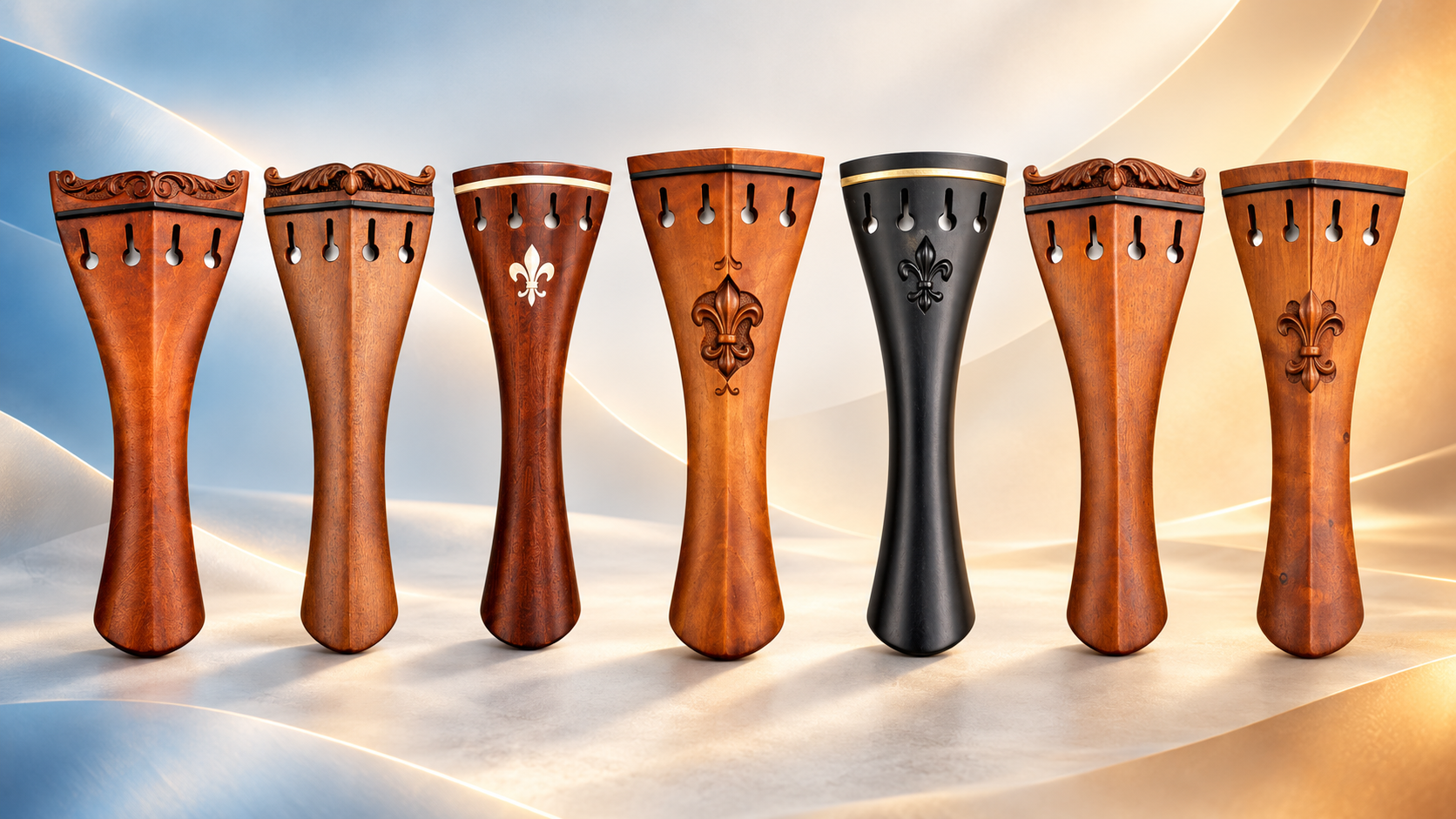
A tailpiece is far more than a decorative detail at the lower end of an instrument. It is part of the vibrating system of the violin or viola and can therefore influence response, tonal colour and balance.
The key question is therefore not: Which tailpiece sounds best? But rather: Which tailpiece suits this instrument?
Especially on high-quality instruments, differences in material, weight, length, shape and mass distribution can be clearly noticeable. A good tailpiece should not impose a foreign character on the instrument. Instead, it should support its existing strengths and encourage the desired tonal direction.
Material, weight and shape belong together
When choosing a tailpiece, the material is often discussed first. Material is important, but it is never the only deciding factor. Several elements work together to influence the sound:
- density and weight
- tailpiece length
- material thickness
- shape
- mass distribution
- afterlength
- the strings being used
- the individual construction of the instrument
This is why two tailpieces made from the same material can react differently on an instrument. At Berdani, we deliberately work with a range of traditional woods and modern alternative materials. Each offers different possibilities in terms of weight, appearance and tonal adjustment.
Castello Boxwood – the basis for Boxwood and Dark Boxwood
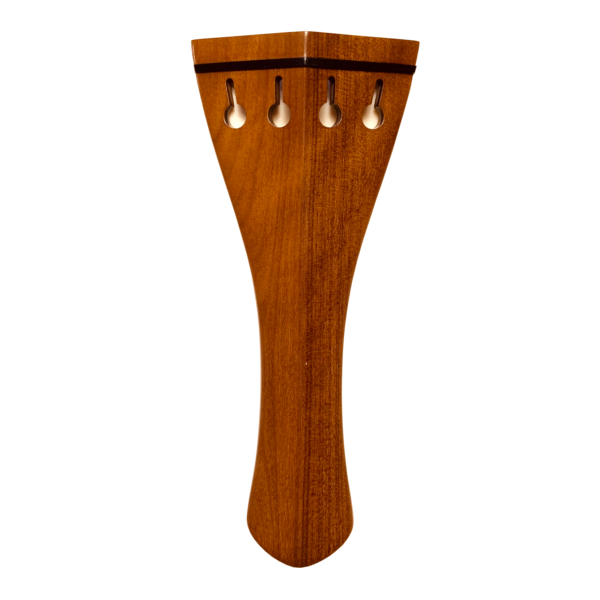
For our Boxwood and Dark Boxwood fittings, we use Castello Boxwood, botanically known as Calycophyllum multiflorum.
The wood has a fine, even structure and can be worked with great precision. Its working properties are similar to European boxwood, while the larger trunk diameters often allow for more uniform material.
For Berdani, Castello Boxwood has one particularly important advantage: it can be coloured extremely well using heat alone.
Our Boxwood and Dark Boxwood parts are thermally treated in a controlled oven process. This changes the colour of the wood without the need for chemical stains, lyes or acids. Afterwards, the surface is only treated with oil.
This is particularly important for components that come into direct contact with the musician’s body: the player is not in contact with a chemically stained surface.
Boxwood – warm medium brown and rich in overtones
Our Boxwood is made from Castello Boxwood and develops its warm, medium-brown colour through controlled heat treatment. The colour does not come from a surface stain, but from the thermal treatment of the wood itself.
Tonally, we value Castello Boxwood for its lively and overtone-rich character. In combination with a suitably lightweight construction, a Castello Boxwood tailpiece can support a quick and free response.
How clearly this effect is perceived always depends on the shape, weight and the individual instrument.
Dark Boxwood – Castello Boxwood in a darker shade
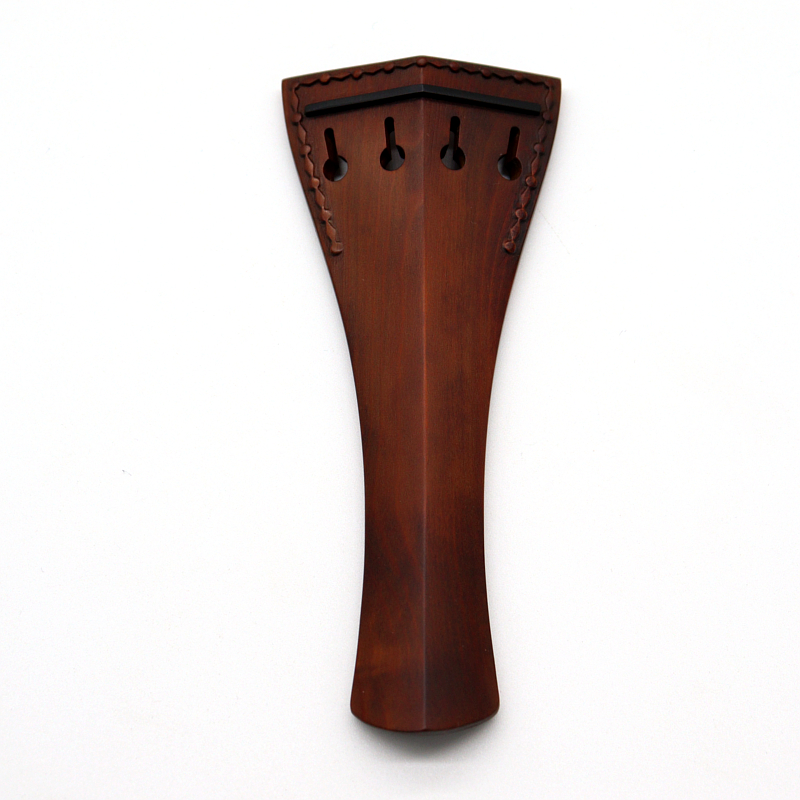
Our Dark Boxwood is also made entirely from Castello Boxwood. It is not a different species of wood.
A more intensive heat treatment creates the characteristic dark-brown colour. Here too, we completely avoid chemical stains, lyes and acids. After the heat treatment, the surface is simply oiled.
Dark Boxwood is especially suitable for musicians who prefer a darker, more understated appearance while still wanting a natural surface. Tonally, the typical characteristics of Castello Boxwood remain.
English Boxwood – dense, fine and steeped in tradition
A different material group is our English Boxwood (Buxus sempervirens). It is one of the densest and finest woods and allows extremely fine details to be worked out.
Our English Boxwood comes from England, has been seasoned for more than 20 years and is significantly heavier than Castello Boxwood. In our production, its weight can be comparable to ebony.
English Boxwood is either used untreated or coloured using a traditional process. The characteristic historical colour is achieved through a traditional treatment using saltpetre and ammonia.
Tonally, we associate high-quality English Boxwood with a brilliant yet warm character.
It is important to distinguish between the two terms: English Boxwood describes the material, while the English tailpiece model describes the shape of the tailpiece.
Central African Ebony
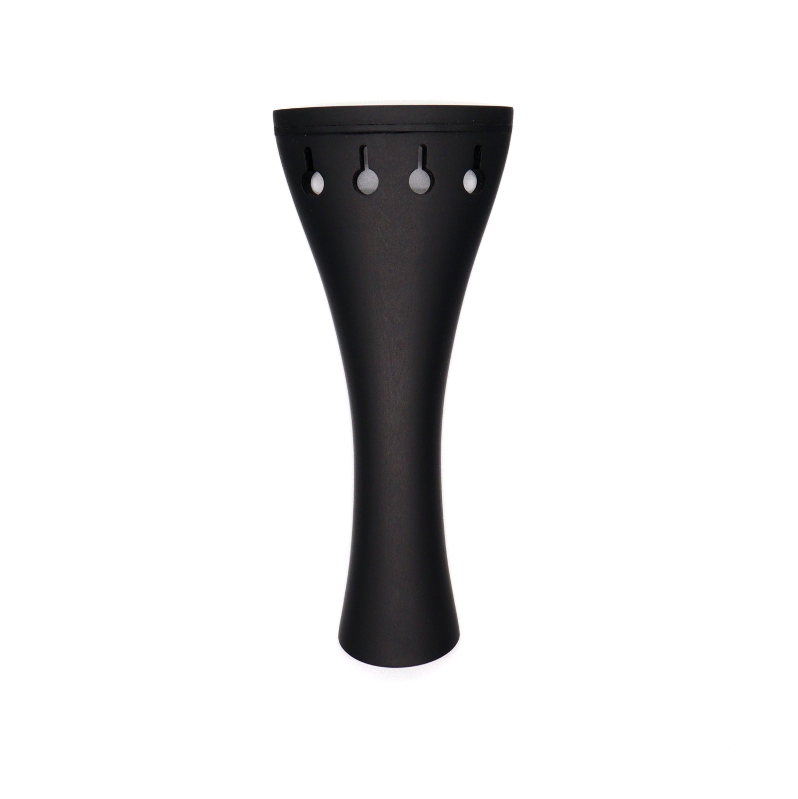
Ebony is one of the classic materials used in violin making. Our Central African Ebony, Diospyros crassiflora, is carefully seasoned and selected according to weight and tonal properties.
Ebony is heavy, hard and highly dimensionally stable, allowing precise and robust tailpieces to be made. Its greater weight can contribute to more calmness, focus and stability on certain instruments.
Our ebony fittings are finely sanded, treated with linseed oil and then polished with wax.
Berdani's Dark Paper – a sustainable alternative to ebony
With Berdani's Dark Paper, we also use a modern alternative to ebony. Dark Paper is made from highly compressed recycled paper and resin.
The material has a dark, elegant appearance and reaches a hardness and density comparable to ebony. It is resistant to moisture, sweat, heat and dirt, and can be worked with traditional violin-making tools.
Dark Paper therefore combines the dark appearance and high density of a traditional material with a modern and sustainable material concept.
Sonowood – densified native wood
Another sustainable material alternative is Sonowood. In this process, native woods are strongly densified, creating a very hard and strong material with high sound velocity.
Sonowood is particularly valued for its fast response and overtone-rich character. This allows native woods to be used in areas where very dense tropical hardwoods have traditionally been employed.
The weight of the tailpiece is crucial
Regardless of material, the mass of a tailpiece plays a central role. A heavier tailpiece can calm an instrument and give the sound more focus and control.
A lighter tailpiece, on the other hand, can support a quicker response, greater mobility and more overtones.
Therefore, neither lighter = better nor heavier = better. The correct mass always depends on the individual instrument.
A very bright and direct instrument often requires a different tonal approach from a violin with a darker and more covered fundamental character.
The French model – fuller, rounder and slightly heavier
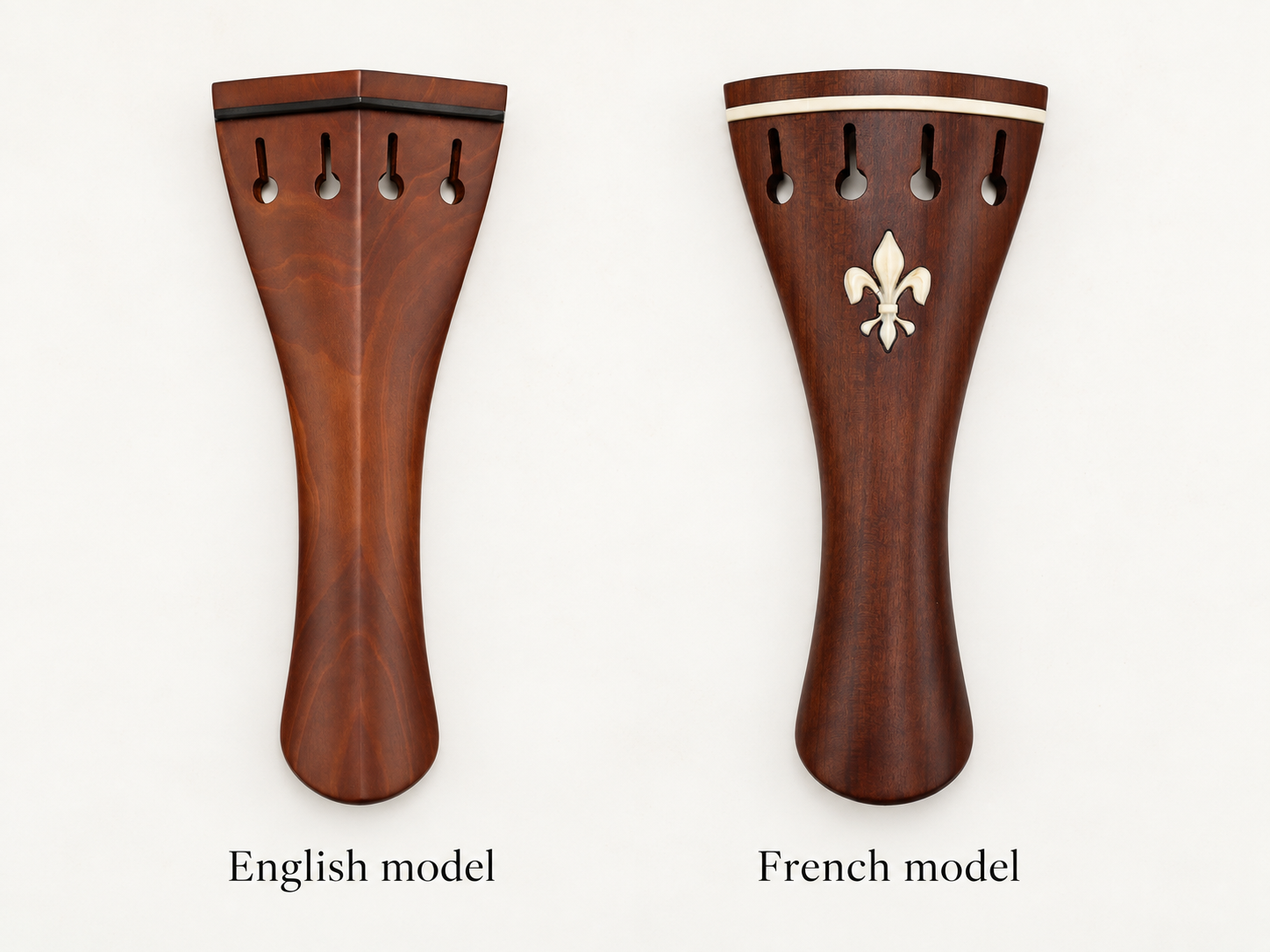
A good example of the importance of shape is our French tailpiece model. This model is slightly more substantial and has more mass.
For this reason, it can be particularly interesting for instruments that sound rather bright or very direct. In our experience, the French model can:
- make the sound appear fuller and rounder
- give the lower strings more substance
- calm an overly brilliant E string
- give the instrument more stability and calmness
Instruments that sound very bright, brilliant or somewhat lean can therefore benefit from the greater mass of the French model.
This does not mean that every bright instrument automatically requires a French model. It simply describes a tonal direction that can be taken into account when making a selection.
The English model – lighter, faster and richer in overtones
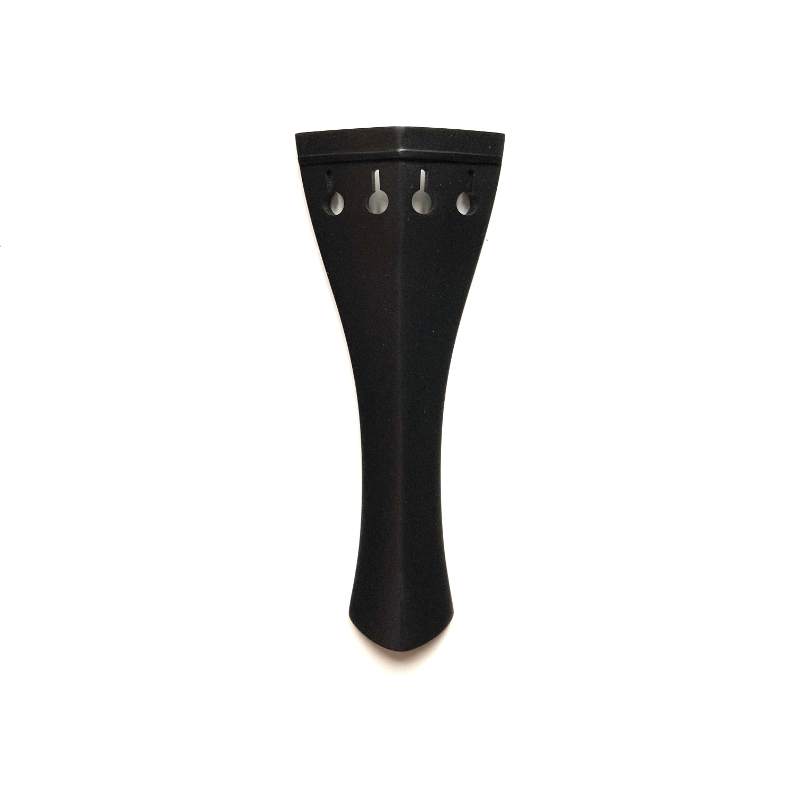
The English tailpiece model is slightly lighter and slimmer than the French model.
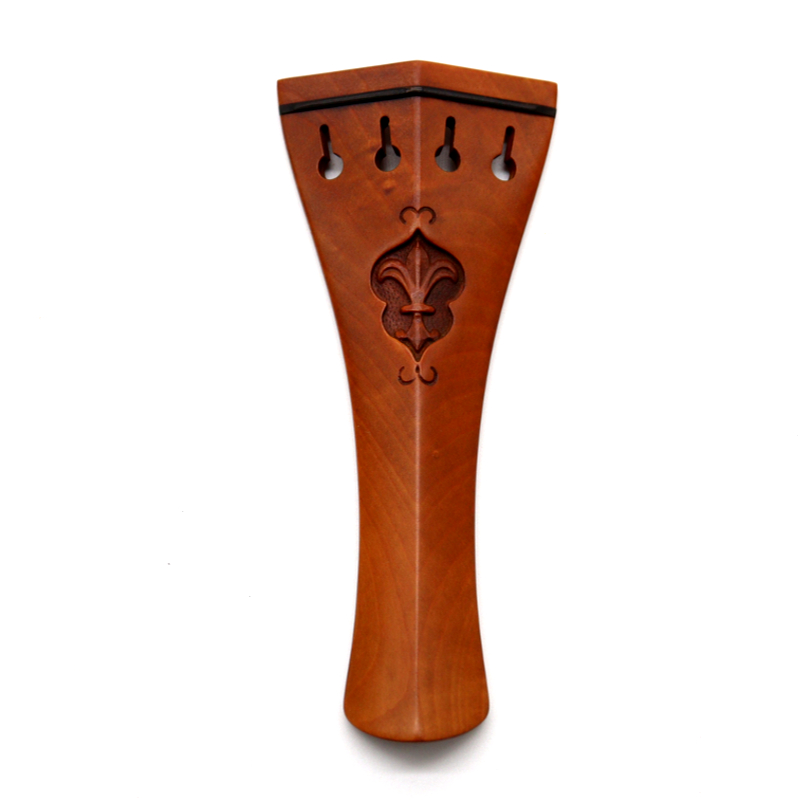
Its characteristic feature is the pronounced central ridge combined with a thinner overall shape. This construction allows the tailpiece to be made with less material while the central ridge still provides the necessary stability.
In our experience, the English model is particularly suitable for instruments that naturally sound darker, warmer or slightly more covered.
Thanks to its lighter and slimmer construction, the instrument can:
- respond more quickly
- develop more brilliance
- show more overtones
- react more openly and freely
French model: slightly heavier, fuller and rounder.
English model: slightly lighter, faster and richer in overtones.
This distinction is not a fixed rule. Every instrument reacts individually, but it provides a useful orientation when looking for a specific tonal change.
Why shape matters so much
Two tailpieces can be made from the same material and even have a similar overall weight, yet still react differently.
Important factors include:
- width
- length
- material thickness
- position of the mass
- overall geometry
The central ridge of the English model is a good example of how closely shape and function are connected. It allows for a thinner construction without losing the required stability.
The broader and more substantial construction of the French model, by contrast, creates greater mass and therefore a different tonal direction.
Afterlength is part of tonal adjustment
The section of string between the bridge and tailpiece also influences the instrument. This so-called afterlength vibrates while playing and forms part of the overall resonant system.
A ratio of approximately 1:6 in relation to the vibrating string length is often used as a traditional guideline. However, this should not be treated as a rigid rule.
Instrument, mensur, strings, bridge position and tailpiece should always be considered together. Even small changes can be noticeable on sensitive instruments.
Fine tuners also change the system
Fine tuners do not only affect convenience. They also change the weight and geometry of the tailpiece.
Four additional fine tuners can make a traditional wooden tailpiece considerably heavier and may therefore alter the intended tonal balance.
For this reason, many musicians use only one fine tuner for the E string with traditional tailpieces. The most suitable solution depends on the instrument, the strings being used and the player’s personal preferences.
Which direction suits which instrument?
Does the instrument sound very bright or brilliant?
A slightly heavier French model may be interesting if the aim is to support more fullness and roundness.
Does the instrument sound rather dark or covered?
A lighter English model may help to encourage more response, brilliance and overtones.
Do the lower strings lack substance?
Additional mass may be worth considering.
Does the instrument respond too slowly?
A lighter tailpiece can be one possible direction.
The decisive factor is always the combination of material, model, weight and instrument.
Berdani – choosing material and shape deliberately
At Berdani, we do not regard a tailpiece simply as an accessory. Material, weight, shape and craftsmanship belong together.
We work with materials including Castello Boxwood, Dark Boxwood, English Boxwood, Central African Ebony, Berdani's Dark Paper and Sonowood.
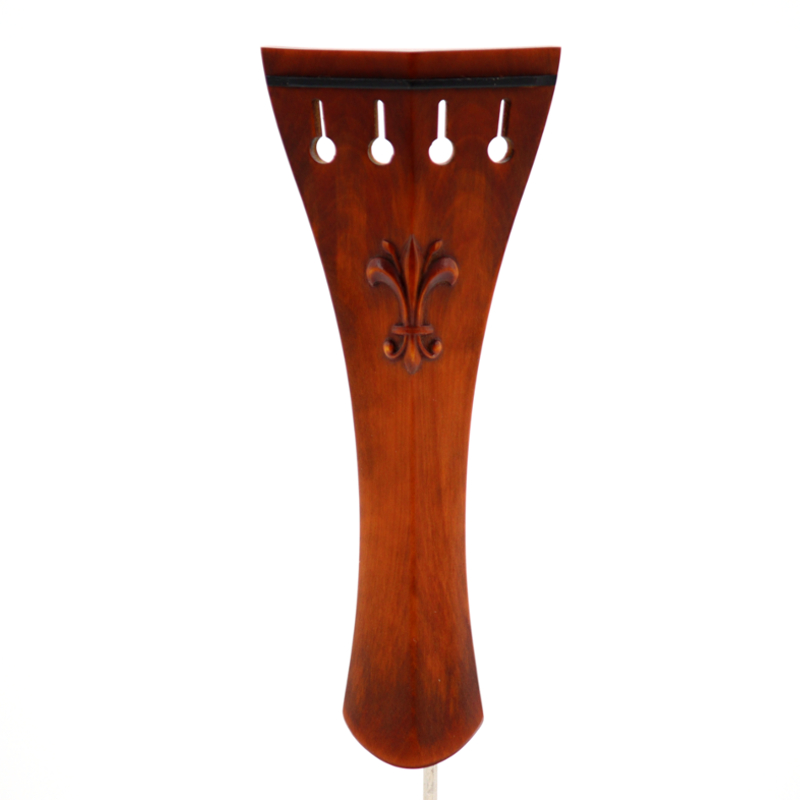
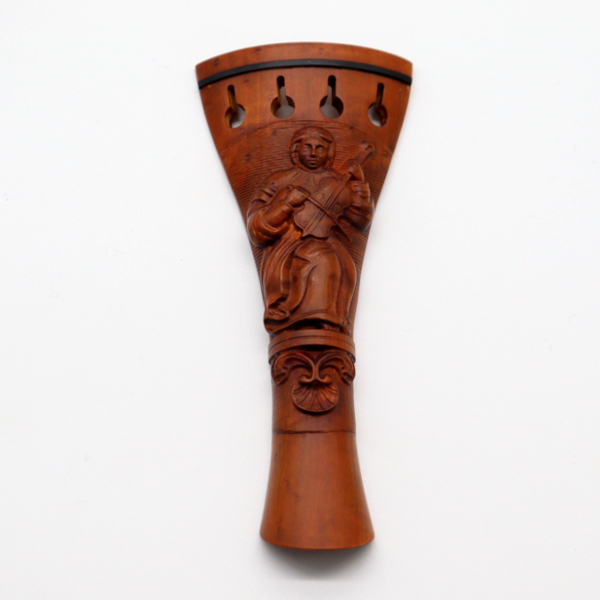
Many of our tailpieces are inspired by historical models and classic forms of violin making. Our goal is not simply to reproduce a historical design.
We want to understand why a particular shape works, where its mass is positioned, how the construction influences response and which model may be suitable for a particular instrument.
There is no single best tailpiece
A tailpiece is well chosen when it suits the instrument. The most expensive, lightest or heaviest tailpiece is not automatically the best.
What matters is the interaction of material, shape, weight, afterlength and instrument.
If a violin responds more freely, sounds more balanced and feels more natural to the player after a change, the adjustment has been successful. This is exactly what we at Berdani consider to be the purpose of a high-quality tailpiece.