
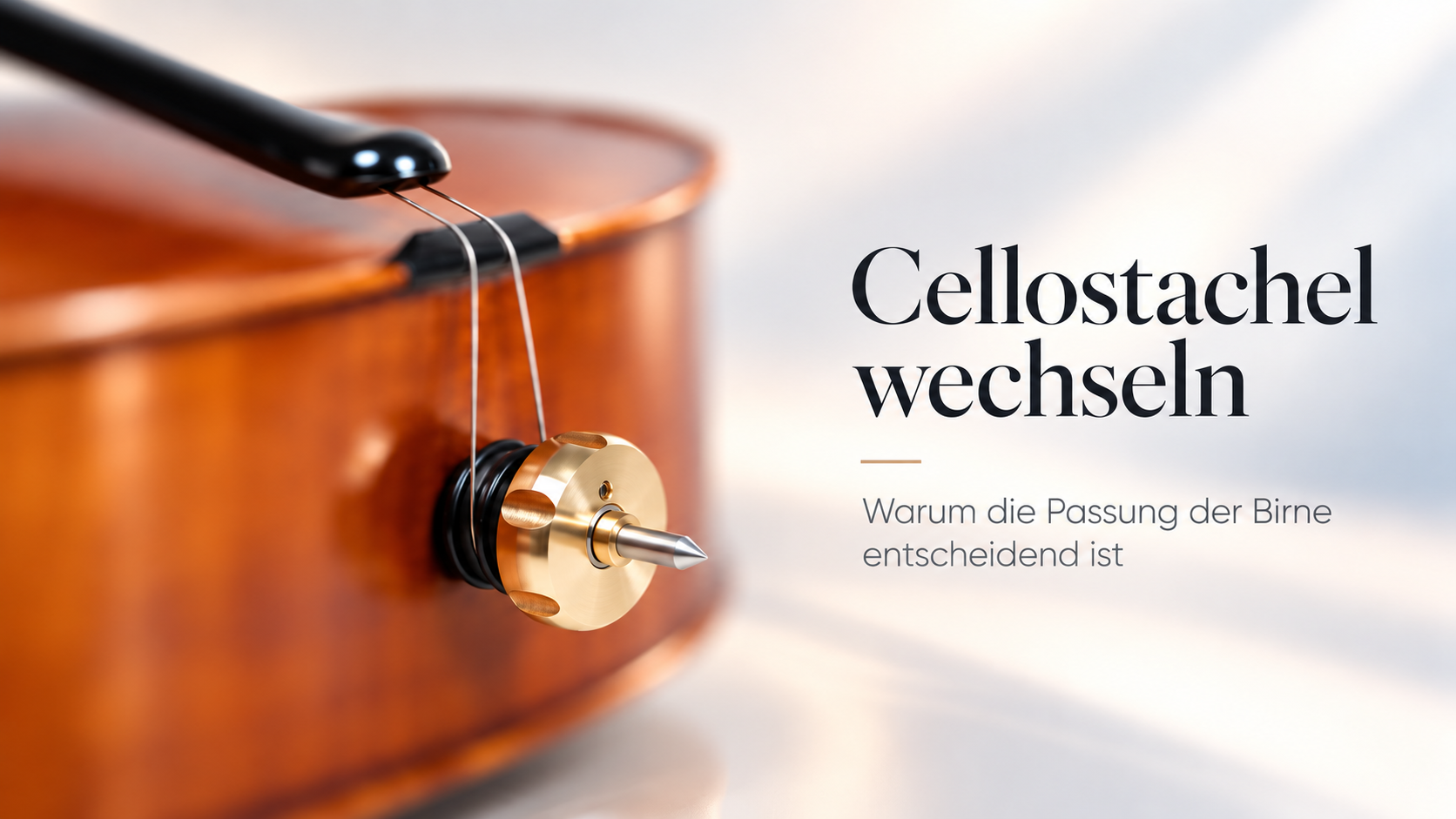
How to Replace a Cello Endpin: Why the Fit of the Endpin Fitting Matters
Replacing a cello endpin may seem like a relatively simple job at first. In reality, the work becomes much more demanding when not only the endpin rod or mechanism is replaced, but also the tapered endpin fitting that sits inside the instrument.
This fitting is seated directly in the lower block of the cello. Its fit is therefore essential for stability, reliable function and the protection of the instrument.
Especially on valuable or historical cellos, as little material as possible should be removed from the instrument itself. A properly fitted endpin fitting should sit firmly and straight without creating unnecessary pressure on the lower block.
What is part of a cello endpin assembly?
In everyday use, the entire unit at the lower end of the cello is often simply referred to as the endpin. Technically, however, it consists of several components.
These include the extendable endpin rod, the mechanism that locks the rod in position and the tapered fitting that sits inside the lower block of the cello.
The fitting forms the connection between the endpin mechanism and the instrument. This is exactly where the quality of the fit determines whether the entire assembly will remain stable and reliable over time.
When should a cello endpin or endpin fitting be replaced?
There are several reasons why a replacement may become necessary.
The mechanism may be worn, the endpin may no longer lock securely or the fitting itself may no longer sit correctly in the instrument. Cracks, pressure marks or damage to the wooden fitting can also make replacement necessary.
Sometimes the reason is also aesthetic. If the pegs, tailpiece and endpin fitting are made from different materials or do not visually match, a coordinated set can create a much more harmonious overall appearance.
However, appearance should never take priority over a technically correct fit.
Warning signs of a poorly fitted cello endpin
The tapered fitting should neither rotate nor move sideways inside the lower block.
Particular attention is required if the fitting moves inside the instrument, the entire endpin assembly rotates, the endpin exits the cello at an obvious angle, a visible gap appears between the fitting and the instrument, the varnish or wood around the lower ribs is damaged, or the fitting begins to move under load.
In these situations, it should first be determined whether the fitting simply needs to be adjusted or whether the hole or lower block has already been altered or damaged.
The taper of the endpin fitting is crucial
The endpin fitting has a tapered shaft. It is therefore not held inside the cello by a straight cylindrical connection, but by a precisely matched taper.
This taper should make even contact with the existing opening in the lower block.
If the fitting is too small, it may move or loosen under load. If it is too large, it should never be forced into the instrument.
An oversized taper can place considerable pressure on the lower block. In the worst case, this may create stress or even damage around the lower block or ribs.
The fitting should therefore never simply be pushed into the existing opening. It must be gradually and carefully adjusted to the instrument.
Why the original opening should be preserved whenever possible
One common mistake when replacing an endpin fitting is unnecessarily enlarging the opening in the instrument.
Every time the hole is reamed, material is permanently removed from the lower block. Particularly on older or valuable instruments, the preferred approach should therefore be to adapt the new fitting to the cello rather than altering the cello to fit the new component.
The less original material is removed, the better.
This is only possible if the existing opening is still technically sound. If it has already been enlarged, damaged or become irregular, a more extensive repair may be necessary.
The lower block carries the load of the endpin
When a cello is played and supported on its endpin, forces are transferred through the endpin assembly into the instrument.
These forces are transmitted through the tapered fitting into the lower block.
For this reason, the fitting must do more than simply look correct from the outside. It needs to sit evenly and securely inside the instrument.
The condition of the lower block cannot always be fully assessed from the outside. Previous repairs, older alterations or small cracks may be present without being immediately visible.
This is why particular care should be taken with older instruments.
How is a new cello endpin fitting adjusted?
First, the existing endpin assembly is carefully removed from the instrument.
The opening, existing taper and condition of the surrounding lower rib area are then inspected.
Only after this examination should the new fitting be adjusted.
Material is removed very gradually from the taper of the fitting, and the fit is checked repeatedly throughout the process.
The aim is to achieve as much even contact as possible across the tapered surface.
A properly fitted component should sit firmly without requiring excessive force to insert it.
The goal is not to make the fitting as tight as possible. What matters is the accuracy of the tapered connection.
The endpin must run straight from the instrument
Once the fitting has been adjusted, the alignment of the endpin mechanism must also be checked.
The cello endpin should extend straight from the instrument and move smoothly in and out.
The locking mechanism must hold the endpin securely without allowing the mechanism or fitting to move inside the cello.
A misaligned assembly is not only visually distracting. It may also cause the load to be transferred unevenly into the lower block.
Which material is suitable for a cello endpin fitting?
The choice of material also plays an important role.
Ideally, the endpin fitting should match the other fittings on the cello. A set looks particularly harmonious when the pegs, tailpiece and endpin fitting are coordinated in terms of wood species, colour and finish.
Ebony has a classic, elegant and understated appearance. Its dark colour works well with many traditional and modern cello fittings.
Boxwood can create a warmer and more historically inspired appearance and works particularly well when the rest of the fittings are made from the same or a similar material.
Other high-quality woods may also be suitable, provided their mechanical properties, weight and workmanship are appropriate for the instrument.
Can the cello endpin fitting influence the sound?
The endpin and its mounting are part of the cello as a complete mechanical system. Weight, material and construction can therefore influence the behaviour of the instrument.
However, any tonal change should not be attributed solely to the endpin fitting.
When adjusting the sound of a cello, the bridge, soundpost, strings, tailpiece, afterlength and the weight and materials of various fittings all work together.
The primary task of the endpin fitting is therefore to provide a safe, precise and stress-free connection between the endpin and the instrument.
These mistakes should be avoided
A poorly fitting component should never be forced or hammered into the cello.
Glue is also not a solution for an inaccurate fit.
A correctly fitted endpin component is held securely by its taper, not by adhesive.
Glue can make future maintenance and repairs considerably more difficult and may cause damage when the fitting eventually needs to be removed.
Oil, wax or other substances should also not be used to compensate for a poor fit.
The underlying problem must always be solved by correctly adjusting the taper.
Why an endpin fitting should not simply be ordered by size
Even if the diameter and external dimensions of a new fitting appear to match the instrument, this does not necessarily mean that the taper fits correctly.
Even small differences in angle or shape can cause the fitting to make contact only at isolated points.
For this reason, a new endpin fitting should always be individually adjusted to the specific cello.
This is one of those areas where true craftsmanship is often found in details that are almost invisible once the work is complete.
When should the cello go to a violin maker?
On valuable or historical instruments, the adjustment of a new endpin fitting should generally be carried out by an experienced violin maker or luthier.
This is particularly important if:
- the fitting is loose,
- the endpin leaves the instrument at an angle,
- the opening has already been significantly enlarged,
- cracks or varnish damage are visible around the lower ribs,
- the mechanism no longer works reliably,
- or the endpin assembly has already been modified several times.
An early and precise correction is usually much less invasive than repairing larger damage later.
Endpin fittings as part of a complete cello setup
At Berdani, we do not regard the endpin fitting as an isolated accessory.
It is part of a complete cello setup and should complement the instrument both technically and visually.
Pegs, tailpiece and endpin fitting form a coherent whole. Wood, colour, proportions, surface finish and craftsmanship should therefore be carefully coordinated.
On high-quality instruments, the difference is often found in these small details.
A well-made endpin fitting does not need to attract attention. It sits precisely, works reliably and integrates naturally into the overall appearance of the cello.
For us, that is what good craftsmanship is about.